It was surprising, then, to find that a great majority is dedicated to the historical implications and context of the novel. The very first sentence is jarring: "Woolf's third novel, Jacob's Room, is her protest against the First World War and the shocking impersonality of its killing machine." (84) To be quite frank, I don't know how much I can agree with that statement. I mean, to be sure, the War figures prominently in the background--but if looked at from a New Critical approach--no, no, let's take it even further. Say some schmuck picks up a copy of the novel on the whim from the library, reads it without any historical context. Would said schmuck even realize the war was featured? The death of Jacob at the end is pretty plain with a little bit of interpretation of literary legerdemain, but dates are hardly ever mention, the War doesn't even appear until the last ten pages, and then only subtly, and Jacob's death is never given detail other than the fact that it happened. Does this really constitute a "protest against the shocking impersonality of its killing machine?" I dunno, maybe. Perhaps Briggs is looking at it from the perspective of the reader-of-the-time, who would probably have the War in the background of his mind whether it's hinted at or not. Or maybe I just didn't get a portion of the novel. But I don't know...
The main reason it's such a big deal is that this first sentence covers a great deal of the article; a large majority of it is focused on Woolf's stance on War, her actions, her beliefs about violence, etc., all in an attempt, I surmised, to encapsulate what she focused on in the novel itself. But I think such a bare-bones interpretation does little more than undo what Woolf was trying to accomplish through her new form; that is, show life in all its vagaries and intricacies--but turning Jacob's Room into a simple war elegy cut all of that out--and, in fact, is incorrect all together, or so it seems to me. I mean, if we were going to compress Jacob to its bare minimum, just from subject matter alone I'd say it's more a testimony to the oppressing power of patriarchy and how it harms both men and women...but that, too, excises a great portion of the novel. It's a lot simpler just to try not to boil down Jacob to its essence in any way; I think Vara Neverow captured Jacob well in her introduction, but lest we forget it's almost half as long as the novel it's introducing.
I do, however, think Briggs' article gets better when she gets down to the nitty-gritty. I think one of her introductions to Jacob is a great testament to the intentions of the novel: "her hero was not to be heroic." (93) Woolf was trying to show the truth of life without all the meaningless fetters--in the post-WWI generation, this was especially necessary. One of my favorite portions of A Farewell to Arms is when Hemingway muses on how the "old words" like honor and glory had lost all significance after the war. Here, Woolf tries to take those old words out of life, too, and show it how it really is.
The article, too, gives good insight to Woolf's conscious intentions: the "multiplying characters, many...glimpsed only momentarily, contrast with the purposeful and elaborately coincidental plot-weaving of the traditional novel..."(96) And it has a really good piece about Woolf's recognition of the need of self-censorship--especially in the realm of sex. Obviously, all the sex in the novel is implied only, and some of it is so vague that we aren't sure what's going on, i.e. the two red-faced people on the beach. And I liked the part about the "Aftermath" of the publication, especially the varied reviews--and of those, especially of
Speaking of Mr. Bennett, I wonder what he would think if he saw today that the only reason he's much remembered is that he's the guy whose vitriol inspired a classic essay which survived long after his condemnations were deemed untoward? Ah, I'm being too harsh, I'm sure he was a good guy.
But I did like Mr. Bennett and Mrs. Brown the most of the essays which we read, with "How to Read a Book" rounding in second. I'll get to the former in the moment. For the latter, I just want to say, Amen! I hate when
Aaaanyway, about that other essay, Mr. Bennett and Mrs. Brown. It was interesting, because I was thinking about the idea of "velocity" in Woolf's work--which is becoming more and more appealing to me--and, more specifically, how it's related to time in her work. Time and its speed being, of course, one of the most ancient of foundations of Science-Fiction (or techno-fantasy), which is my favorite genre of writing. I remember reading somewhere, actually, that Woolf really enjoyed Sci-Fi. It was in the Lee biography, and it was just the barest mention of a passage--something about her enjoying the idea of a telephone with viewscreen and something. And this makes sense, as in her lifetime Sci-Fi really reached hitherto unseen heights of popularity (that most of this was pulp is beside the point).
Anyway, time. Time has always been an obsession of Sci-Fi; Pop Quiz: what's one of the first truly sci-fi novels ever written? Ever? Yes, the Time Machine. From the beginnings of its existence, Sci-Fi and time go hand in hand. Since Woolf likes Sci-Fi, it follows that her interest in Time, and its velocity, is of an, at the very least, academic interest to her. Even in Jacob's Room, it occupies an unstated forefront, being both obviously present and completely obfuscated simultaneously. The book is supposed to describe the fleeting life of the main character---the book is only 187 pages long. Velocity is literally used as a deciding factor in length to highlight one of its myriad points. Likewise, inside the novel, the velocity hits a fevered pace and rarely slows down, save when Woolf herself, as narrator, interjects a longer paragraph. And yet most of the scenes in the novels are glimpses--like a stone skipping along the surface of Time, touching just long enough to cause ripples, which eddy and curl into each other. Then the stone sinks and disappears forever, and like a snap of the finger, the velocity cuts to zero with the final image of a pair of shoes.
This does have something to do with Mrs. Brown, I promise. In fact, I'll get to it right here. What does Sci-Fi and Mrs. Brown have in common? I actually recognized the name of Mrs. Brown, and the wording of some passages sounded very familiar, until it hit me, that Ursula K. Le Guin had written an essay on Mrs. Brown in her wonderful critical collection, The Language of the Night (which is so good I'm almost tempted to go out and just get the thing off Amazon, since it's out of print).
Le Guin is one of my favorite writers, and took her place among them with surprising alacrity, seeing that I only heard of her about half a year ago or so. At her best, she a vanilla frappe on a hot day while sitting in the shade; at her worse, and that means, when her stories are barely disguised Tracts on whatever axe she has to grind, she's still like that roller coaster at the theme park that makes you sick and yet which you still want to ride again.
In any case, her essay is entitled "Science Fiction and Mrs. Brown." It was published in 1975, so just by happenstance it's dated, yet most of it's subject matter, I think, is not. She talks about whether Sci-Fi--still stuck in a critical ghetto in 1975, lest we forget--I mean, this is even before STAR WARS came out--she talks about whether sci-fi can accurately represent Mrs. Brown the way Virginia Woolf intended. On the surface, Le Guin says, Brown seems a little too round for archetypal Captains and intragalactic colonization, and Le Guin hypothesizes that Woolf herself would say that Sci-Fi would be unable to contain Mrs. Brown. Considering the Sci-Fi around before Woolf's death, one would be hard pressed to blame her. Even the best stuff--A Brave New World--had very little character, was more of a lens to possible society.
But Sci-Fi evolves, like all art forms. So it goes from Utopia to pulp to Humanity--robots and Foundations and Asimov--but without Mrs Brown.
But then something happens in the world of Fantasy. Something that very few saw coming and most didn't know how to interpret. An, at first, rather silly story of two short people whose entire task is to throw a wedding ring into a volcano. This, according to Le Guin, is where Mrs. Brown began to filter into Fantasy/Sci-Fi: while Frodo, himself, is not necessarily round enough to be Mrs. Brown, Frodo, Sam, Golom and Smeagol are composite enough to be her. Sci-Fi/Fantasy couldn't yet pull off a single Mrs. Brown, but it was possible for her to get in there, even through the lens of four or five characters.
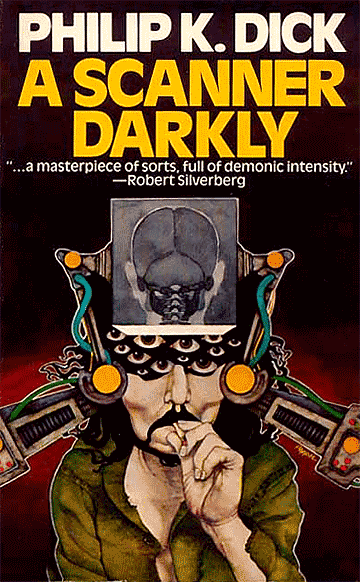
After Lord of the Rings, fantasy, and, by association, Sci-Fi experienced a sort of renaissance, where greater care was finally taken to focus on character. Le Guin sights Philip K. Dick, another of my faves, as an example. Sci-Fi had finally "figured itself out" in a way; it knew what it could do and now that it had been established, it could focus on the more difficult, portentous parts of life, such as human complexity.
It's interesting to see this in hindsight, because if anything, Sci-Fi/Fantasy has, ironically, grown in esteem in both the eyes of critics AND the public, rather a rare thing. And the appearance of Mrs. Brown in Sci-Fi is nowadays so commonplace it's not even an event. Her name is Ender Wiggen, her name is Darth Vader, her name is Shadow, Jack Torrance, Father and Son, Bob Arctor, Arthur Dent, all of these incredible characters burned into our brains, representing a panorama of life that might, just might, make even Virginia Woolf whistle in amazement.



No comments:
Post a Comment